What It Takes To Ensure a Healthy Democracy
During a recent discussion on election laws and civic engagement, panelists discussed the role of election officials and voters in ensuring a healthy democracy and asserting local authority during a time when federal authorities have been seeking to expand power over elections.
“I think maybe the most important thing these days is the fact that we still have a federal system,” said panelist Dante Scala, Professor of Political Science at the University of New Hampshire.

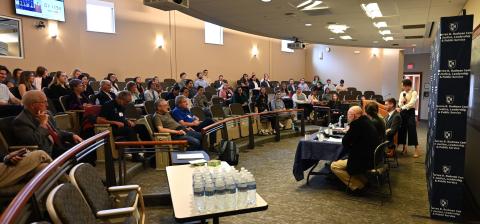
Mariana Galindo Marquez, Brendan O’Donnell, Jonathan Kipp, Anna Brown, Dante Scala
"Even when faced with orders from the executive branch, states have the leverage to say politely, but firmly, ‘No, we're not about to do that.’”
New Hampshire was among many states that resisted the Trump Administration’s demand for voter files that include confidential information such as Social Security and driver’s license numbers, leading to a U.S. Dept. of Justice lawsuit. A federal judge sided with the N.H. Secretary of State but the DOJ has since appealed to the 1st Circuit Court of Appeals.
"Democracy in Practice: Law, Elections, and Civic Participation" was hosted by the University of New Hampshire Law Review and the Warren B. Rudman Center for Justice, Leadership & Public Service.
Panelists included Anna Brown, Executive Director of the Rudman Center for Justice; Jonathan Kipp, Londonderry Town Moderator; Brendan O’Donnell, Deputy Secretary of State for New Hampshire; and Dante Scala, Professor of Political Science at the University of New Hampshire.
Mariana Galindo Marquez moderated the discussion. In her 3rd year at the UNH Franklin Pierce School of Law, she is the symposium editor for the UNH Law Review and president of the Hispanic and Latin American Law Students Association.
Watch the discussion here.
(Quotes in this piece have been edited slightly for brevity and clarity.)
On what a healthy democracy looks like at the state and local level beyond simply holding elections:
Brendan O’Donnell pointed to two aspects he considers vital to a healthy democracy. “One is accountability -- and there are so many variations of accountability. And the other is distribution of power. New Hampshire has one of the coolest statutes – the Right to Know Law, which can be so frustrating when you're a member of the government, but its core purpose is to make sure that the government always remains accountable and responsive to the people. And we have this constitutional provision that reaffirms that.”
For Jonathan Kipp, accountability is a two-way street. “Our citizens need to hold our governments accountable, and the government, to the extent that it can happen, needs to hold our citizens accountable,” he said. “Knowledgeable citizens: Be involved in your community, learn how the town works, or the city, serve on a board, and that helps all of us to understand how our democracy is working.”
Anna Brown described the persuasive power of individual citizens and the potential impact of a single vote. “I spend a lot of time looking at the New Hampshire legislature and we are one of the states where every single bill gets a public hearing. And I've seen many legislative examples where legislators are swayed because someone shows up in the room and they become the expert in the room. So, I would argue that civic health can't just be showing up at the voting booths. It is also all the other ways that you participate.”
“I always love bringing up the many, many, many examples in New Hampshire where elections are decided by sometimes a single vote,” Brown said. “In the primary that just happened on September 8th, a primary for state representative was decided by a single vote. There were two other primaries, one in Manchester and one in Farmington, that came in as a tie. Then they have to go through the recount process at the Secretary of State’s office.”
On election integrity and gaining the confidence of voters:
Brendan O’Connell described the meticulous system for recounting ballots, which includes counting teams and “a whole chain of custody for the ballots.”
“They bring out the ballots. The recounters will have a camera facing on the table, and they'll have monitors that face each candidate or their representative. They will see how every individual ballot is marked. They'll see the tally sheet and how every single ballot is marked on the tally sheet,” he said.
“The tally sheets then need to be reconciled before they're brought over. If there's a challenge, it's dealt with publicly; they're called over and they can make arguments if, for instance, there's a write-in name and they're confused about who it might be.”
Londonderry residents trust their election officials and election results, said Jonathan Kipp.
“There are three things our election team focuses on. We want every voter to believe that their vote was counted, our entire results are accurate, and that every voter who's eligible had an opportunity to vote,” he said.
New Hampshire’s prompt election results also instill confidence, Dante Scala said. In some cases, states have waited days and even weeks for results. “When you have that delay, regardless of the process, I think that inevitably brings doubts and allows people to sow doubts in people's minds,” he said. “We know results that evening or the next morning at most in a very close election,” he said.
On the importance of conceding defeat:
“At a minimum, in a healthy democracy, losers accept that they're losers and have lost to the winners. And that sounds like a very basic thing,” said Dante Scala. “We all know that over the last decade, it's become anything but that.”
“We have an awful lot of elections in New Hampshire at all different levels, and I can't think of a case where the loser did not accept that he had lost to the winner. There have been recounts for sure, but there's a process for that. And it's a good process to follow. But in democracies, losers accept that they've lost and will try again next time, perhaps,” he said. “It sounds minimal, but I think it's important, especially given what we've seen from the current occupant of the White House.”
President Trump has continued to falsely claim the 2020 election was rigged, despite investigations and court cases that have all found he lost to former President Joe Biden.

